
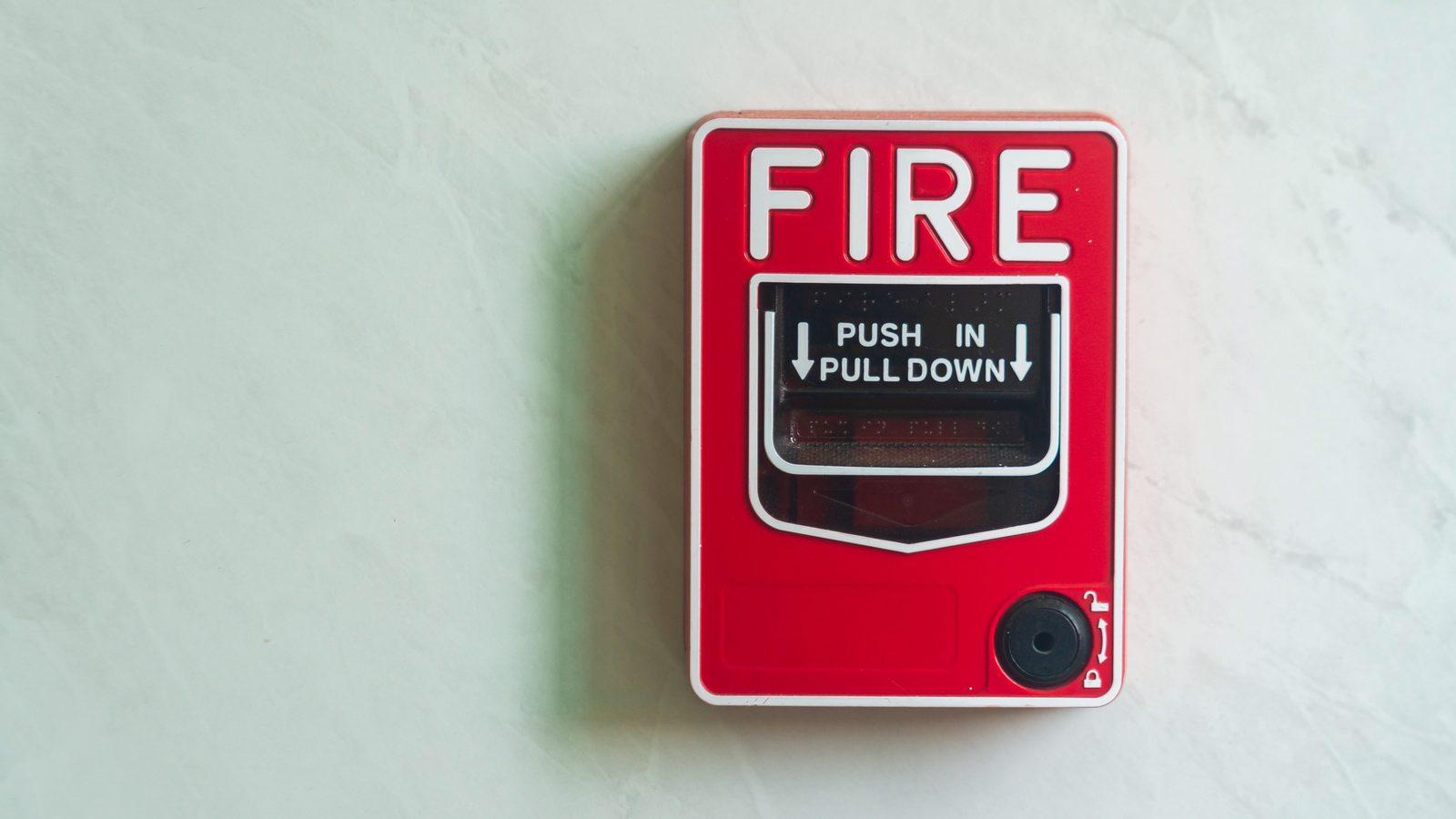
Fire alarm panel phone lines: what NFPA 72 requires
A fire alarm panel does not need two phone lines, or any copper line. NFPA 72 permits a single path that meets three figures, unless your fire authority says otherwise. We review your lines for free and supply a path that meets them.
The three figures a replacement path has to meet
60minutes
The path checks in at least this often, and if it fails, the monitoring company hears within the same hour.
90seconds
From an alarm in your building to its display and recording at the monitoring company.
24hours
Of backup power for each device the signal passes through, the router or cellular unit included.
These are the figures for a single path. Your fire authority decides whether a single path is allowed in your building, under which edition of the code and with which local amendments. Read the clause and the full requirements.
When the copper goes, and how the panel moves
Many panels still report through a dialer on a copper line. If AT&T stops that service in your area and the copper is the panel’s only way out, alarms stop reaching the monitoring company. The free review tells you which path each line can take, what it costs and what it will and will not do, so you go to your alarm contractor with options in hand.
We find out what the panel dials
We record the panel’s make and model, how it reports to the monitoring company and which numbers its dialer calls. If nobody in the building knows what the dialer calls, that is the first thing we establish.
Your alarm contractor and the authority having jurisdiction see the plan early
They test and approve the finished system, so they hear the plan while it can still change. A local amendment can be stricter than the published code, and the time to find one is before any equipment is ordered.
We supply the circuit and the voice service, and your alarm contractor does the panel work and the acceptance test. From there the job follows our cutover sequence for Bay Area buildings. If the walk-through also turns up elevator phones, a different code applies to them, set out in our guide to elevator phone line requirements.
Two phone lines? Where that rule comes from
The two-line arrangement people remember was written for one kind of communicator, the DACT, which dials the monitoring company over a phone line. Even there, a second phone line has been a fallback that needs your fire authority’s approval, in the 2013, 2022 and 2025 editions alike.
- 2013
- One phone line plus one other means of transmission. A second phone line is allowed only by exception, where the other means are not available and the authority approves.
- 2022
- The clause is renumbered 26.6.4.2.4.1 and the second phone line becomes item (4), still conditional on approval. A DACT must connect to a managed facilities-based voice network.
- 2025
- TIA 25-1 deletes “shall employ” and “legacy POTS”. The clause now applies to a DACT that uses a phone line and no longer requires one.
Read the clause text
2013
“A system employing a DACT shall employ one telephone line (number). In addition, one of the following transmission means shall be employed:
- (1) One-way private radio alarm system
- (2) Two-way RF multiplex system
- (3) Transmission means complying with 26.6.3.1
Exception: Where access to two technologies in the preceding list is not available at the protected premises, with the approval of the authority having jurisdiction, a telephone line (number) shall be permitted to be used as the second transmission means.”
The exception goes on to require the DACT to call a second receiver line when the first call fails, and to be able to switch to whichever means still works.
2025, as revised by TIA 25-1
NFPA issued Tentative Interim Amendment 25-1 on April 18, 2024, effective May 8, 2024, and approved its text for incorporation before the edition was printed.
“A system employing a DACT that uses a single telephone line (number) shall also include one of the following transmission channels…”
The annex note the amendment added, A.26.6.4.2.4.1, states that the requirements “are not intended to prevent a system using a DACT from employing two transmission channels from a managed facilities-based voice network (MFVN) in accordance with 26.6.4.2.1.”
NFPA 72 permits a single communications path
“Unless prohibited by the enforcing authority, governing laws, codes, or standards, where a single communications path is used, the following requirements shall be met:
- (1) The path shall be supervised at an interval of not more than 60 minutes.
- (2) A failure of the path shall be annunciated at the supervising station within not more than 60 minutes.
- (3) The failure to complete a signal transmission shall be annunciated at the protected premises in accordance with Section 10.15.”
A copper telephone line is powered by the telephone company, so the line keeps working through a building power outage, and it carries a voltage the panel watches for trouble; our guide to what a POTS line is covers how the pair does that. Whatever replaces the line has to keep working through an outage on power supplied inside the building, and has to signal its own failure within the intervals in 26.6.3.3.
What NFPA 72 asks of a single path and of multiple paths
| Requirement | Single path (26.6.3.3) | Two or more paths (26.6.3.4) | What to establish in your building |
|---|---|---|---|
| Supervision of the path | Every 60 minutes or less | Each path every 6 hours or less | Get the check-in interval in writing and watch it during the acceptance test |
| A path failure reaching the supervising station | Reported within 60 minutes | A failure of any path reported within 6 hours | Who at the monitoring company sees it, and what their contract says they do |
| A signal transmission that does not complete | Indicated at the protected premises, per Section 10.15 | Something in the building has to show it; an alert in a vendor’s web portal does not count | |
| Independence of the paths | Does not apply | No single point of failure can take down more than one path | List what the paths share, such as a router, power supply or cable route, and remove it |
| End-to-end alarm time | 90 seconds or less from initiation to display and recording (26.6.3.8) | Time it on the installed path, from the room the equipment will live in | |
| Secondary power at the premises | 24 hours for every transmitter and shared device the signal passes through, with narrow exceptions (26.6.3.13.1) | The same for the first path; equipment used only by the extra paths can be exempt (26.6.3.13.1.2) | List every powered device from the panel to the network, router included, and check its hours on backup |
| Whether a single path is allowed at all | Only where the authority, laws or codes do not prohibit it | No such condition | Ask the authority having jurisdiction, and under which code edition and local amendments |
Supervision of the path
- Single path (26.6.3.3)
- Every 60 minutes or less
- Two or more paths (26.6.3.4)
- Each path every 6 hours or less
- What to establish in your building
- Get the check-in interval in writing and watch it during the acceptance test
A path failure reaching the supervising station
- Single path (26.6.3.3)
- Reported within 60 minutes
- Two or more paths (26.6.3.4)
- A failure of any path reported within 6 hours
- What to establish in your building
- Who at the monitoring company sees it, and what their contract says they do
A signal transmission that does not complete
- Single or multiple paths
- Indicated at the protected premises, per Section 10.15
- What to establish in your building
- Something in the building has to show it; an alert in a vendor’s web portal does not count
Independence of the paths
- Single path (26.6.3.3)
- Does not apply
- Two or more paths (26.6.3.4)
- No single point of failure can take down more than one path
- What to establish in your building
- List what the paths share, such as a router, power supply or cable route, and remove it
End-to-end alarm time
- Single or multiple paths
- 90 seconds or less from initiation to display and recording (26.6.3.8)
- What to establish in your building
- Time it on the installed path, from the room the equipment will live in
Secondary power at the premises
- Single path (26.6.3.3)
- 24 hours for every transmitter and shared device the signal passes through, with narrow exceptions (26.6.3.13.1)
- Two or more paths (26.6.3.4)
- The same for the first path; equipment used only by the extra paths can be exempt (26.6.3.13.1.2)
- What to establish in your building
- List every powered device from the panel to the network, router included, and check its hours on backup
Whether a single path is allowed at all
- Single path (26.6.3.3)
- Only where the authority, laws or codes do not prohibit it
- Two or more paths (26.6.3.4)
- No such condition
- What to establish in your building
- Ask the authority having jurisdiction, and under which code edition and local amendments
NFPA 72, National Fire Alarm and Signaling Code (2022 ed.), Chapter 26. Where a cellular unit hands dial tone back to the panel, the same rows apply to the unit; how those units work, and the two batteries involved, is covered under POTS in a box.
What UL 864 and the FCC’s backup power rule cover
UL 864 covers the panel and its accessories
UL 864, the Standard for Control Units and Accessories for Fire Alarm Systems, sets requirements for control units and their accessories, amplifiers and power supplies (§1.1). It covers that equipment for use in accordance with standards that include NFPA 72 and NFPA 70 (§1.2), and it does not determine compliance with FCC rules (§1.8). The path from the panel to the monitoring company belongs to the installation, and NFPA 72 governs the installation.
No federal backup power rule covers a business line
The FCC’s backup power rule, numbered 47 CFR §12.5 until 2020 and §9.20 after that, covered only residential voice service, stopped being in effect on September 1, 2025 and was removed from the rules on March 16, 2026, so the secondary power NFPA 72 asks for at the premises has to be designed into your own installation.
Fire alarm panel phone line questions
No. A second telephone line is a fallback for a panel that reports through a DACT, allowed only where the other transmission means are not available and the authority having jurisdiction approves, and a panel on a single path that meets 26.6.3.3 needs no telephone line at all. The fallback appears in each of the 2013, 2022 and 2025 editions of the DACT clause.
The code allows it. NFPA 72 (2022 ed.) 26.6.3.1 permits communications methods other than those the chapter covers specifically, provided they meet the performance requirements of 26.6.3 and the code’s other applicable requirements, and 26.6.3.3 lets such a method run as the only path on the terms in that clause, unless the enforcing authority, governing laws, codes or standards prohibit it. Whether your installation meets those terms is settled when it is tested and inspected.
The authority having jurisdiction. It decides which edition of NFPA 72 applies and with which local amendments, and it approves the installed system after your alarm contractor’s acceptance test. A listing covers a piece of equipment, such as a communicator; the approval covers the system as installed in your building.
Bring the panel model number and the phone bill
With those two we match every line on the bill to the device it serves, starting with the panel’s dialer, and quote a replacement path for each line still in use.